A cobbled street looks like chaos until you know what you are looking at. Then it becomes a set of instructions. This is a road built for carts. This is a square built to impress. This is a lane nobody ever got round to finishing properly. The pattern under your feet is usually the quickest clue to who paid for the street, what travelled along it, and how often somebody had to dig it up.
What follows is a plain guide to the main patterns you will meet on streets, squares, yards and lanes, how to tell them apart, and what each one tends to say about a place.
Strictly speaking, a cobble is a rounded, water-worn stone of the kind you find on a beach or in a riverbed. A sett is a quarried block, roughly squared off, with a flat top and fairly straight edges. A flag is a large flat slab, and belongs to pavements and yards rather than roads.
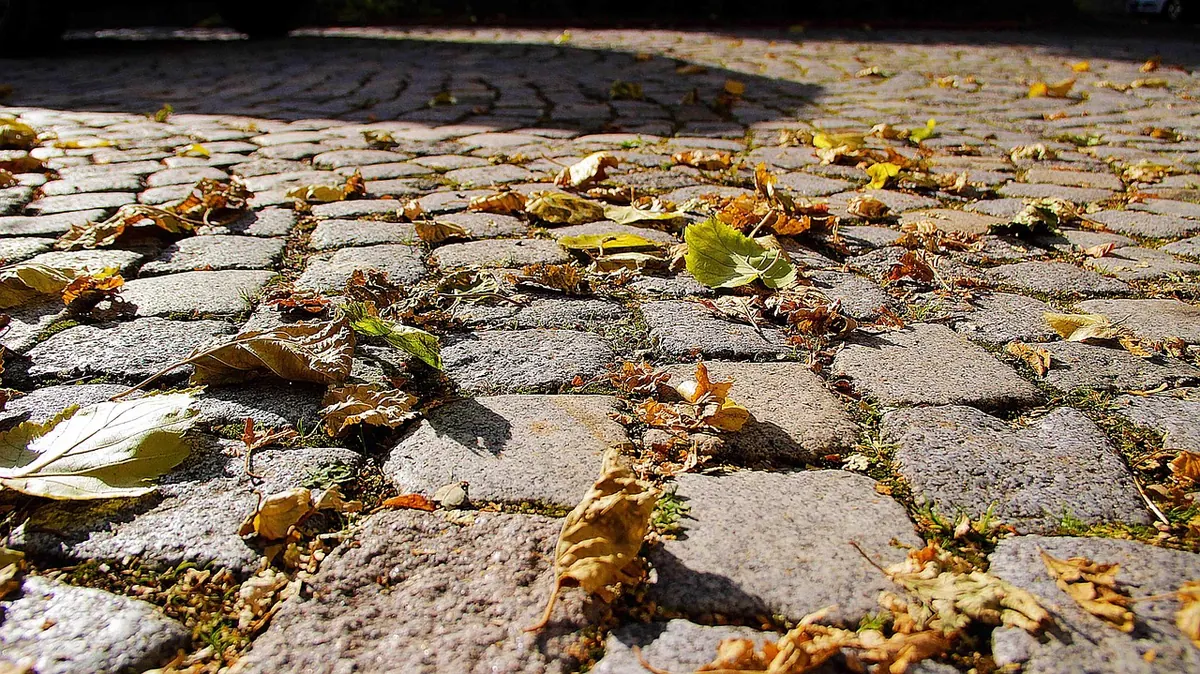
Most streets visitors call cobbled are actually setted. The distinction matters, because only setts can be laid in tidy courses or sweeping fans — rounded cobbles simply will not sit in a straight line for long. If you can see orderly rows, you are looking at setts. If the surface rolls and dips like a basket of eggs, you are looking at cobbles.
There is a practical reason for the confusion. Cobbles were cheap and local, gathered from riverbeds and beaches, and they were used for the roughest jobs: yard surfaces, farm tracks, the apron of a quay. Setts had to be quarried, dressed and carted, so they were reserved for places where the surface had to work hard. When you find a street of true cobbles, you are often standing somewhere that mattered less to whoever was paying the bill.
Coursed work is the everyday pattern and the easiest to read. Setts of similar size are laid in rows, called courses, running parallel to one another. On a carriageway they are normally laid across the line of travel rather than along it, so that wheels cross the joints instead of running in them. That single decision made the surface last far longer and made repairs far simpler: a rutted course could be lifted and relaid without disturbing the rest.
You will find coursed setts on main streets, market places, bridge approaches and anywhere that carried serious wheeled traffic. It is the pattern of a road with a job to do and somebody responsible for keeping it in order.
Size is another quiet giveaway. Setts on a busy through-route tend to be large and uniform, because heavy stones spread the load and take far longer to wear out. Setts on a narrow side street or a service yard are often smaller and more mixed, laid by whoever was available with whatever was left over from a bigger job.
Fan paving is setts laid in overlapping semi-circles, each arc radiating outward and locking into the next. It is the most recognisable pattern in Britain and much of northern Europe, and in this country it is largely a nineteenth-century taste. Look for it in market squares, promenades, station forecourts, civic spaces and the smarter residential squares.
Fans were not only for show. Because no long straight joint runs in one direction, the surface spreads the weight of wheels and hooves evenly. The setts also hold each other in place, which is why so many fan-paved spaces have survived decades of traffic. The cost was skill and labour: fan work needs smaller, more carefully dressed stones and a layer who knows exactly where each arc begins.
To spot a fan from ground level, get low and look across the space rather than down at your feet. The arcs almost vanish from standing height, and become unmistakable from a crouch, especially when the stones are wet and a low sun catches every ridge.
Random paving uses whatever came to hand — mixed sizes, mixed shapes, mixed geology, laid flat side up and tamped into place. There is no pattern to follow and no pretence about it. This is the paving of service alleys, mews, back yards, farm tracks and the humbler edges of a town.
Rubble is the rougher cousin: undressed stones, often no more than broken rock, packed together with earth or small chips to fill the gaps. It drains badly, it is unforgiving underfoot, and it was usually laid by the people who had to use it.
Reading random paving is a lesson in economics rather than design. Nobody spent money here because nobody expected to gain anything by it. When a lane suddenly switches from rubble to neat coursed setts halfway along, follow the change — you have just crossed a boundary between one landowner and the next, or reached the point where a wealthy household decided the approach to its door was worth improving.
Once you start looking, two more arrangements show up regularly.
Herringbone sets rectangular stones at right angles to one another in a zigzag, so that every stone locks against its neighbours. It is common in brick as well as stone, and turns up on slopes, driveways and yards where a stable surface mattered more than elegance. It resists shifting well because the pattern has no continuous line of weakness running through it.
Radial paving arranges courses in concentric circles or in spokes fanning out from a centre, often around a monument, a well or the centre of a grand square. It is pure civic theatre: the pattern exists to draw the eye inward and to tell you that this is a designed space with a middle.
You will also meet chequer work, alternating light and dark stones to make a visible grid, and stretches of plain flagged surface where a street was later given over entirely to people on foot.
Pattern is only half the story. The other half is damage, and it is often more revealing than the original design.
A street is not finished when the last stone is laid. It is finished when nobody digs it up again, and that almost never happens.
If you want a quick method, work through it in this order.
None of this requires a guidebook. It requires ten seconds of crouching and a willingness to look slightly odd in public. Do it once and you will never walk down an old street the same way again: the ground stops being scenery and starts being evidence.
Photo: tinoehrhardt90 / Pixabay