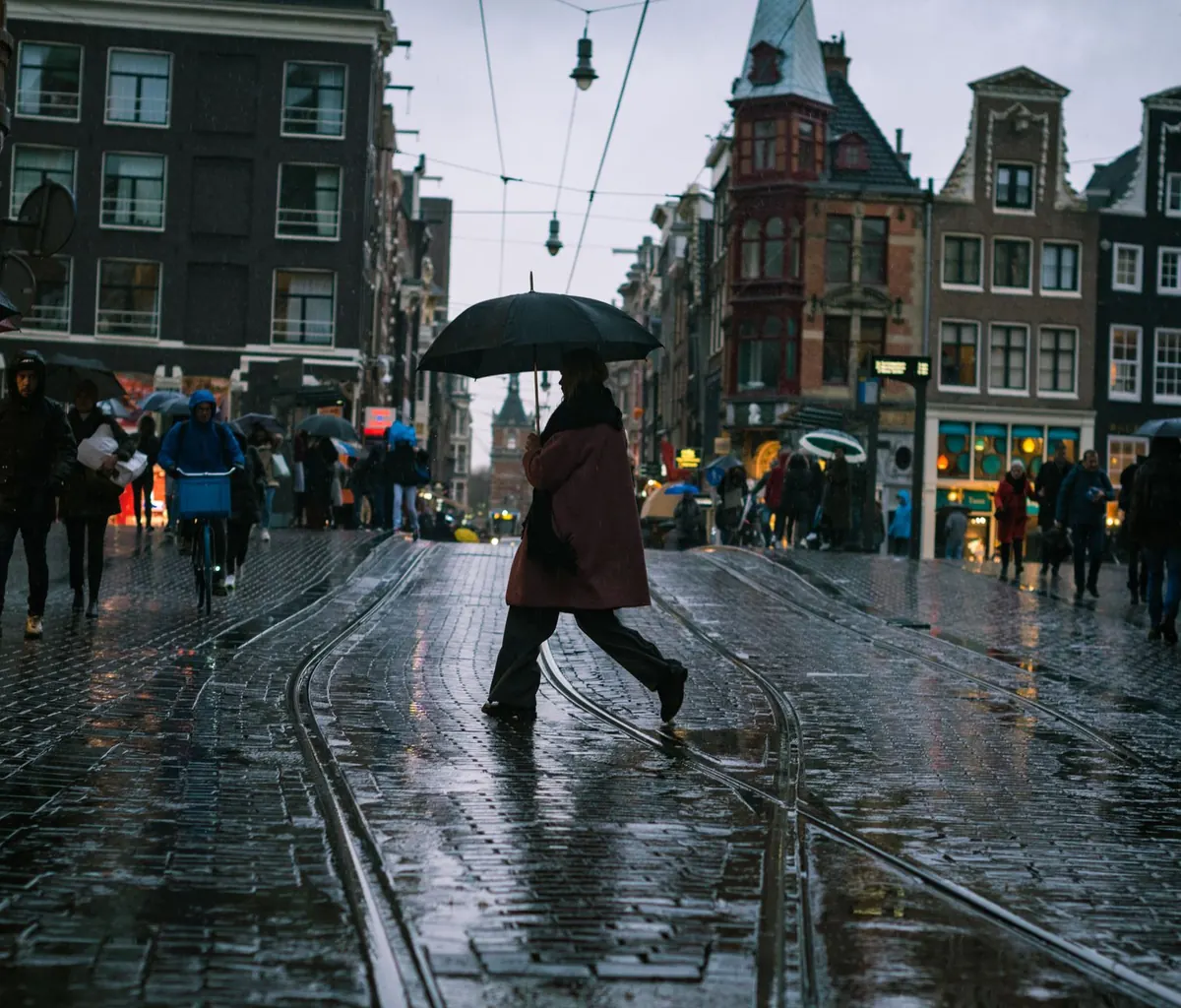
Rain empties a street and then fills it with two. Cobbles go dark and glossy, lamplight spreads across the stones like spilled paint, and every puddle holds an upside-down version of the town. Most people pack the camera away in this weather. That is exactly why the photographs are worth having.
Dry cobblestones give you texture and not much else: pale, low in contrast, honest but flat. Water changes three things at once. It darkens the stone, which deepens every shadow and makes the gaps between the stones read as drawn lines. It settles in the low spots, turning hollows into mirrors. And it catches whatever light is going — a lamp, a shop window, a car's headlights — and scatters it into small bright points across the surface.
The result is a street with twice the light and half the people. Reflections lift detail into the darker half of the frame, exactly where you would normally lose it, and wet evenings tend to empty the pavements. Umbrellas, a lone cyclist, a taxi's tail lights, and clear space to work in: a combination you rarely get on a dry Saturday afternoon.
Weather windows matter more than gear. The best light for reflective cobbles comes in the half hour after rain eases, or at blue hour when the lamps are on and the sky still holds some colour. Shooting during rain gives you streaks and droplets; shooting just after gives you calm water and clean reflections. Decide which one you want before you leave the house, because they call for different shutter speeds.
A puddle only fills the frame when the camera is close to the water. Standing up, you photograph a puddle. Kneeling down, you photograph a street. Aim to hold the camera roughly 10–20cm above the surface and tilt it gently downwards, so the reflection occupies the bottom of the frame and the real building sits above it. Kneeling also keeps you steadier than crouching, and keeps the horizon straight.
Polished kerbs, a drainage channel running down the middle of a lane, the dip outside a doorway, a gutter holding an inch of water — all of these reflect. So do wet cars and shop windows. A narrow strip of water in a gutter makes a long, thin picture of whatever stands above it, which is often more interesting than a full mirror.
Read the street before you set anything up. Notice which lamps are lit, which windows are bright, where the ground falls away, and where the stone is smooth rather than churned. Two minutes of looking saves twenty minutes of wandering.
Start in aperture priority at f/8. That usually gives enough depth of field to hold both the reflection and the real building sharp while you hand-hold at dusk. Open up to f/2.8 or f/4 if you want a single reflected lamp to sit against soft stone. Keep ISO between 400 and 1600 — a little grain in dark water is fine, camera shake is not.
For handheld work, stay at 1/60sec or faster. Rain streaks read best around 1/30–1/60sec against a dark background. If you can brace the camera on a wall or kerb, drop to 1/4sec or a full second to smooth ripples into one continuous mirror. Expose for the reflection rather than the street: minus two-thirds or a full stop of exposure compensation is a sensible starting point, because wet stone is dark and bright reflections blow out fast. Shoot raw if you can; mixed street lighting is easier to sort out later.
Position yourself so a light source sits just outside the frame but inside the puddle. A lamp behind your shoulder throws a long reflection towards the camera; a lit shop window offers both colour and reflected lettering. Cold blue sky against warm lamps gives you a colour contrast that needs almost no editing afterwards.
An off-camera flash at low power, held low and to one side, can lift a puddle that would otherwise be a dull grey shape. Gel it warm and it blends with the street. A small torch raked across the stones at a shallow angle is even simpler: it makes every ridge cast a shadow, which is how you show texture that flat light hides. Avoid pointing a flash straight down at wet stone from the camera; you will get hotspots and little else.
Think of the frame as split between the real and the reflected. Two-thirds reflection to one-third street is a reliable default, and the waterline where wet stone meets mirror often works well as a low horizon. Look for repeats — an arch, a spire, a hanging sign, a lamp — and let them appear twice. Do not be afraid to fill the whole frame with water either; a picture that is entirely reflection makes the viewer work out which way up it is.
Puddle edges are frames in their own right: a dark irregular border around a bright reflected sky. Include them when the shape is interesting, crop past them when it is not.
When you edit, do less than you think. Lift the shadows a touch, keep the blacks black, and add only a little contrast or clarity to the stone. Over-sharpened water looks like noise. Correct mixed lighting selectively where your software allows: a lamp that reads orange next to a window that reads green usually needs one of the two tamed. Reduce noise in dark areas rather than brightening them into mush.
Photo: Vasily Kleymenov / Pexels