Stand on almost any old British street and you are probably standing on setts. Most people call them cobbles, and nobody is going to arrest you for it, but the two are not the same thing. One is a rounded stone shaped by water and ice. The other is a quarried block, cut and dressed to size. Knowing which is which changes how you read a street.
A cobble is a naturally rounded stone. Geologists put the size range at roughly 64mm to 256mm across — bigger than gravel, smaller than a boulder — but the size matters less than the shape. Cobbles have been rolled about by moving water or ice, usually in a riverbed, on a beach, or within the glacial till that blankets much of Britain. That journey wears every corner round.
Because they come from so many sources, a cobbled surface is a mix of rock types. One stretch of riverbank might give you granite, flint, quartzite and a little basalt, none of it matching. Laid on the street, cobbles were often set on edge in rough rows — you can sometimes spot the vertical bedding — and the joints between them are wide and irregular, because round stones leave gaps when you pack them together.
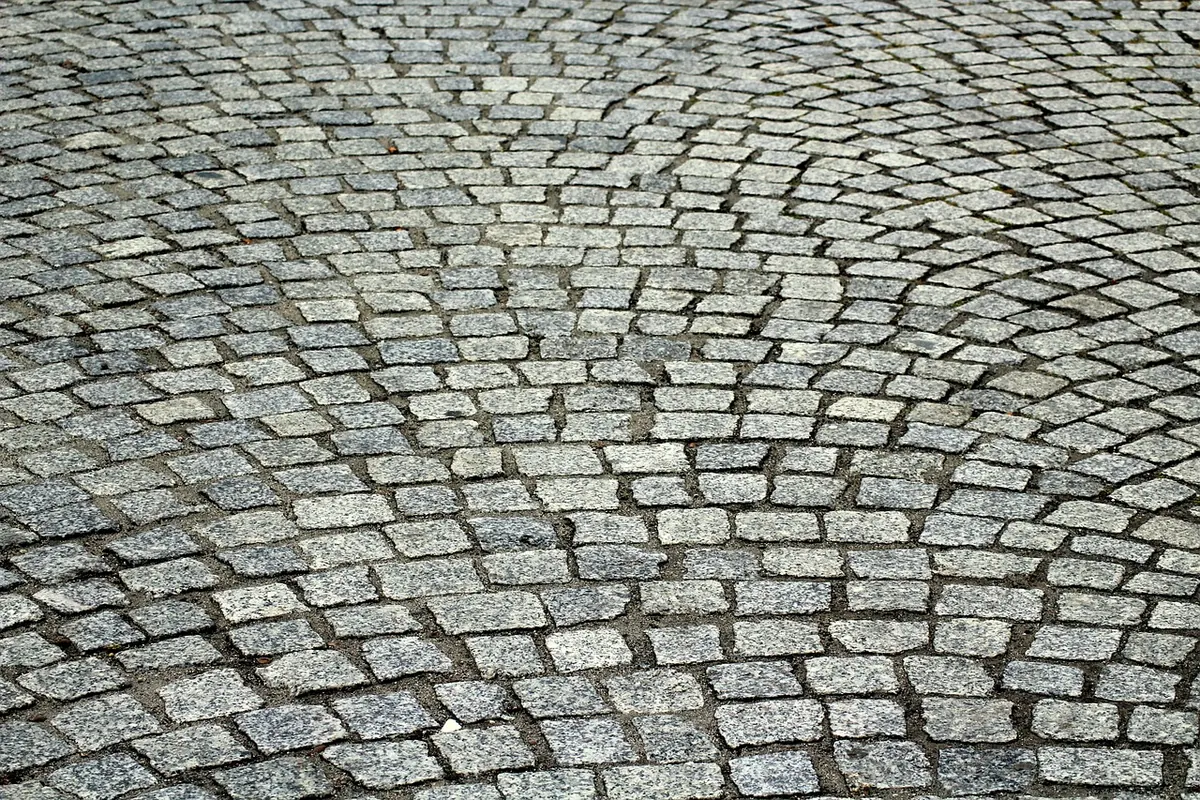
Setts are quarried and shaped. A quarryman split a block of bedrock, by hand with plugs and feathers or a chisel, and from the nineteenth century onward increasingly by machine, then dressed it into a rough cube or brick. The top is flattened, the sides squared, the corners knocked back enough to make the stone handleable and to let it sit snug against its neighbours.
Sizes vary by region and era, but most setts fall somewhere around 100mm to 200mm across the top and 75mm to 150mm deep. Because they come from a single seam, a sett street is usually one rock type from end to end: dark whinstone across parts of Scotland and northern England, grey granite in Aberdeen and Cornwall, buff and grey millstone grit through the Pennines, limestone in some southern towns.
Old setts carry the marks of their making. Crouch down and you will often find diagonal chisel scars or the shallow round dimples of a punch. Later, saw-cut setts show finer, straighter marks.
The shorthand is simple. Cobbles are sediment: loose material that was transported, abraded and dumped, which is why they are rounded and mixed. Setts are bedrock: stone extracted in place, which is why they are angular, uniform and matched.
Cobbles are shaped by water. Setts are shaped by hand.
That difference shows up in the weathering, too. Rounded cobbles present a curved face to the weather and to your boot, and their wide joints collect grit, moss and water. Squared setts shed water across a flatter surface and their tighter joints hold a bedding course more predictably.
The confusion in the language is old. Victorian writers often used "cobble" for any small paving stone, and the habit stuck. Most surviving stone carriageways, market places and hill streets in Britain are setts — cobbles turn up more often in yards, river walls, decorative bands and the odd stretch of medieval paving.
Next time you are standing on a stone surface, try this in order:
A hand run over the surface tells you plenty, too. Cobbles undulate; setts are flatter, with the small ridges and dips of wear and settlement.
If you walk, cycle, push a pram or use a wheelchair, the surface underfoot is not a detail. Rounded cobbles are uneven and their gaps are wide enough to catch a narrow wheel or a walking stick. Setts, laid well, give a flatter ride — which is exactly why they took over from cobbles on busy carriageways as wheeled traffic increased.
Grip varies more by stone than by type. A wet, polished granite sett can be treacherous; a riven grit or whinstone sett with a bit of texture holds better. Either way, the open joints of traditional stone paving let water drain between the stones rather than sitting on the surface. Once those joints are sealed with modern mortar or resin, that drainage largely stops.
Repair is the other practical difference. A sett surface can be lifted stone by stone and relaid without obvious scarring. Cobbles are harder to match, because you cannot simply order another batch of the same mix — the character of the surface comes from its randomness.
For a small patch on private ground, the sequence matters more than the speed:
On a public highway, or on any surface within a conservation area or the curtilage of a listed building, check with the local authority before you alter anything. Changes to a surface can need consent, and the conservation or highways team will usually advise on matching materials.
Crouch down next time you are on a stone street. If the stone under your hand is round, mismatched and worn smooth by water, it is a cobble. If it is squared, uniform and carries the marks of a chisel or a saw, it is a sett. Use the right word and you will see the street differently — as a record of what the local ground gave, and what people did with it.
Photo: _Alicja_ / Pixabay